✦ Art & Expression
Arts & Design in Islam
01
Islamic Arts & Designs —
02
A Comprehensive Exploration
Islamic art and design are vibrant and diverse fields, reflecting the rich cultural and religious heritage of the Islamic world. Spanning from the 7th century to the present day and encompassing regions from Spain to Southeast Asia, Islamic art is characterized by its intricate patterns, calligraphy, architectural innovations, and symbolic floral motifs.
03
Foundations and Principles
Islamic art is deeply rooted in the principles of the Islamic faith, which emphasize the unity and order of creation. This is often reflected in the abstract and non-figurative nature of Islamic art. The prohibition against depicting living beings, based on Islamic teachings, has led artists to develop other means of expression, such as geometric patterns, arabesques, and calligraphy. Following are some key characteristics:
04
Calligraphy
Calligraphy holds a special place in Islamic art, as the written word is highly esteemed in Islam. The Quran is traditionally handwritten in beautiful, elaborate scripts. Various styles of Arabic calligraphy have evolved since over the centuries, each with its distinct characteristics:
- Kufic: This is the oldest form of Arabic script, characterized by its angular, geometric letters. Kufic is often used in architectural inscriptions and Quranic manuscripts.
- Naskh: A more cursive and readable script, Naskh became the standard for copying the Quran and other manuscripts. Its rounded and flowing letters make it highly legible.
- Thuluth: Known for its large, elegant letters and elongated verticals, Thuluth is often used for decorative purposes in architecture and manuscripts.
- Diwani: Originating in the Ottoman Empire, Diwani is a highly ornate and intricate script, used primarily in official documents and royal decrees.
- Persian Nastalik: Developed in Persia, this flowing and elegant script is commonly used in Persian poetry and literary works.
Calligraphy is not limited to manuscripts; it is also found on architectural elements, ceramics, metalwork, and textiles, where it often serves both decorative and communicative functions.
05
Geometric Patterns
Geometric patterns are a hallmark of Islamic art, reflecting the mathematical and scientific achievements of the Islamic Golden Age. These patterns often consist of repeated shapes such as stars, polygons, and complex interlaced designs, creating a sense of order and harmony. The use of geometry symbolizes the infinite nature of Allah and the underlying structure of the universe.
The construction of geometric patterns involves a high degree of mathematical precision and creativity. Artists use techniques like tessellation (tiling a plane with no gaps or overlaps) and recursive division to create intricate designs that are both aesthetically pleasing and intellectually stimulating.
06
Arabesque
Arabesque designs feature intricate, flowing patterns of leaves, vines, and tendrils. These motifs are often symmetrical and endlessly repeating, symbolizing the interconnectedness of nature and the Divine order of creation. Arabesques are used in various forms of Islamic art, including architecture, textiles, manuscripts, and ceramics.
The arabesque style often combines geometric and floral elements, creating a harmonious blend of natural and abstract forms. This reflects the Islamic belief in the unity and harmony of all creation.
07
Architecture
Islamic architecture is renowned for its grandeur and intricate details, combining functional and decorative elements to create awe-inspiring structures. Key features of Islamic architecture include:
- Domes: Symbolizing the vault of heaven, domes are a prominent feature in mosques and palaces. The interior of domes is often adorned with intricate tile work and calligraphy.
- Minarets: Tall, slender towers from which the call to prayer is announced. Minarets are both functional and decorative, adding to the skyline of Islamic cities.
- Courtyards: Central open spaces in mosques and palaces, often featuring fountains or gardens. Courtyards provide a tranquil space for contemplation and social interaction.
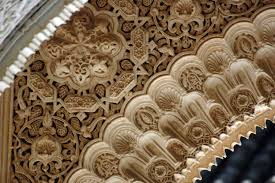
- Muqarnas: Stalactite-like decorations that adorn domes, arches, and vaults. Muqarnas create a play of light and shadow, adding depth and complexity to architectural surfaces.
- Iwan: A vaulted hall or space, open on one side, commonly found in mosques and palaces. The iwan serves as a transitional space between the interior and exterior.
Notable examples of Islamic architecture include the Alhambra in Spain, the Great Mosque of Córdoba, the Dome of the Rock in Jerusalem, and the Blue Mosque in Istanbul. These structures are celebrated for their innovative use of space, light, and decoration.
08
Tile Work and Mosaics
Tile work and mosaics are extensively used in Islamic architecture, creating vibrant and intricate surfaces that cover floors, walls, and ceilings. Islamic tiles often feature geometric and floral patterns, calligraphy, and vibrant colours. The use of glazed tiles allows for a wide range of colours and textures, adding to the visual richness of the decoration.
Mosaics, made from small pieces of coloured glass, stone, or ceramic, are used to create detailed images and patterns. The technique of assembling mosaics requires great skill and precision, resulting in stunning compositions that adorn mosques, palaces, and other significant buildings.
09
Textiles
Textiles are an integral part of Islamic art and culture. Carpets, rugs, and fabrics are often richly decorated with geometric, floral, and calligraphic designs. These textiles serve both functional and decorative purposes, playing a significant role in daily life and religious practices.
Persian carpets, known for their intricate patterns and high-quality craftsmanship, are among the most famous examples of Islamic textiles. These carpets often feature complex designs that incorporate geometric and floral motifs, as well as medallions and borders.
10
Manuscript Illumination
Manuscript illumination refers to the embellishment of books and scrolls with intricate designs, calligraphy, and miniatures. This art form is particularly associated with Quranic manuscripts, where each page is meticulously decorated to honour the sacred text. Illuminated manuscripts often include gold leaf and vibrant colours, creating a visually rich and spiritual experience.
In addition to religious texts, illuminated manuscripts also include works of literature, science, and history. The illustrations and decorations in these manuscripts provide valuable insights into the cultural and intellectual life of the Islamic world.
11
Glassware
Islamic glassware is celebrated for its delicate craftsmanship and intricate designs. Glass objects often feature vibrant colors and decorative patterns, demonstrating the skill and creativity of Islamic glassmakers. Common items include lamps, bottles, and bowls, each showcasing the beauty and sophistication of Islamic design.
12
Metalwork
Islamic metalwork encompasses a wide range of finely crafted objects made from brass, bronze, and other metals. These items often feature inlaid patterns, calligraphy, and decorative motifs. Common objects include lamps, bowls, trays, and incense burners, each demonstrating exceptional craftsmanship.
The techniques used in Islamic metalwork, such as engraving, inlaying, and casting, reflect the high level of skill and creativity of Islamic artisans. Metal objects are not only functional but also serve as works of art, showcasing the beauty and sophistication of Islamic design.
13
Ceramics
Islamic ceramics include pottery and glazed tiles, adorned with elaborate patterns and calligraphy. These ceramics are valued for both their aesthetic appeal and practical use. Notable examples include Iznik pottery from Turkey used extensively in Ottoman architecture (e.g., Blue Mosque, Rüstem Pasha Mosque), known for its vibrant colours and intricate designs. Kashan ceramics from Iran included bowls, bottles, plates, tiles; and architectural pieces from the Kashan lusterware was widely exported across the Islamic world. These are celebrated for their high-quality craftsmanship.
Islamic ceramics often feature geometric and floral motifs, as well as scenes from literature and daily life. The use of glaze allows for a wide range of colours and textures, creating visually stunning pieces that are both functional and decorative.
14
Woodwork
Woodwork in Islamic art involves the creation of intricately carved wooden objects, including furniture, doors, and screens. These pieces often display geometric and floral designs, showcasing the versatility and artistic potential of wood as a medium.
Islamic woodworkers use techniques such as carving, inlaying, and marquetry to create detailed and complex designs. Wooden objects are not only functional but also serve as decorative elements, adding warmth and beauty to Islamic interiors.
15
Coins and Medallions
Islamic coins and medallions are beautifully designed with calligraphy and geometric patterns. They often carry religious and cultural significance, featuring inscriptions and sometimes portraits of rulers. Islamic coins reflect the economic and political history of the Islamic world, as well as its artistic achievements.
16
Painting and Miniatures
Islamic civilisation developed a strong preference for non‑figurative art — especially in religious spaces — because of a principle known as aniconism — the principle of avoidance of depicting sentient beings. This wasn’t about suppressing creativity. It was about protecting the purity of worship and avoiding anything that could lead to:
- idolisation
- hero‑worship
- attributing divine qualities to human figures
- distraction in sacred spaces
Previous to and in early Islamic history, Muslims lived among cultures where statues, icons, and images were worshipped. Islam emphasised a clean, distraction‑free environment for worship — focusing the heart on God alone. Muslim artists developed some of the world’s most sophisticated:
- geometric patterns
- arabesque floral designs
- calligraphy
- tilework
- architecture
This is why Islamic art feels so mathematical, rhythmic, and infinite — it reflects the unity and transcendence of God. hich led to the rise of the unique geometric and calligraphic beauty we now associate with Islamic civilisation.
While early Islamic art avoided figurative representation painting, and miniatures became prominent in later periods, especially in Persian and Mughal art. These works often depict historical events, literary scenes, and courtly life, characterized by their detailed and vivid imagery.
Islamic miniatures are small (some of the smallest handwritten Qur’ans known are from the Ottoman and Mughal periods during the 17th – 19th century- about 2 x 2 cm) and detailed paintings that illustrate manuscripts and books. They often feature intricate compositions, vibrant colours, and fine details, reflecting the artistic and cultural achievements of the Islamic world.
17
Conclusion
Islamic art and design represent a unique and diverse artistic tradition, characterized by its emphasis on abstract and non-figurative forms, intricate patterns, and symbolic motifs. From calligraphy and geometric patterns to architecture and textiles, Islamic art reflects the cultural and religious values of the Islamic world, offering a glimpse into its rich heritage and history.
Each piece of Islamic art, whether a beautifully decorated manuscript, an intricately designed ceramic, or a grand architectural masterpiece, tells a story of creativity, spirituality, and cultural exchange. Islamic art continues to inspire and captivate audiences around the world, demonstrating the enduring power of artistic expression to transcend time and place.