

✦ Gratitude
Contentment
A State of Inner Ease and Moral Clarity
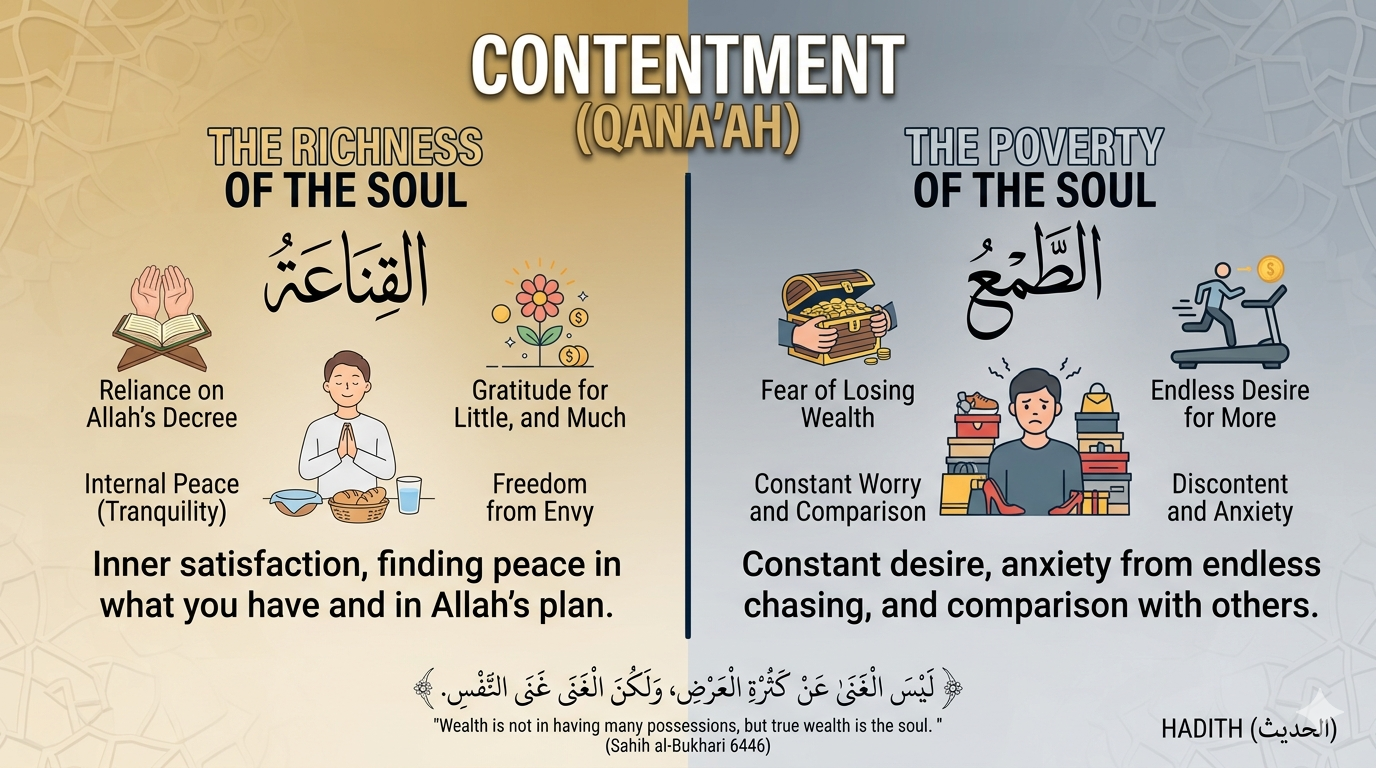
Contentment — sometimes described in classical Islamic ethics as qanā‘ah — is not passive acceptance or lack of ambition. It is a deep inner ease that arises when the heart is free from envy, comparison, and restless desire.
The Qur’an and the Prophetic teachings present contentment as a form of spiritual intelligence: the ability to recognise what truly matters, to appreciate what one has, and to trust in the wisdom of God’s decree.
01
Freedom From the Tyranny of Want
Modern life often fuels a constant sense of “not enough.” Contentment breaks this cycle.
The Qur’an reminds us that “in God’s remembrance do hearts find rest” (Chapter 13, verse 28), pointing to a peace that is not tied to possessions or circumstances.
Contentment is the opposite of greed; it is the ability to feel whole without needing more. It is not about having little — it is about not being owned by what we have or what we lack.
02
The Prophetic Teaching on True Wealth
Prophet Muhammad (peace be upon him) defined contentment with striking clarity: “True richness is the richness of the soul.” He lived simply, gave generously, and never allowed material abundance or scarcity to shape his sense of worth.
His contentment was not resignation; it was strength — the strength to remain grateful in ease and patient in difficulty. Through his (pbuh) example, contentment becomes a form of dignity: a refusal to let worldly measures define one’s value.
03
Trusting in God’s Provision
Contentment grows from a heart that trusts in God’s wisdom and timing. The Qur’an teaches that sustenance is ultimately in God’s hands, and that every person receives what is best for them.
This trust does not negate effort; Islam encourages striving, excellence, and ambition. But it frees the heart from anxiety over outcomes.
A contented person works with sincerity, then rests in the knowledge that what reaches them was meant for them, and what misses them was never theirs.
04
Contentment and the Gratitude Arc
Indebted Gratitude awakens awareness of blessings. Humility softens the ego and opens the heart. Contentment is the inner peace that follows — the quiet confidence that one’s worth is not tied to status, wealth, or comparison.
Together, these virtues form a moral arc that grounds the human being in clarity, gratitude, and balance.
05
A Source of Strength in a Competitive World
In a culture that often measures success through accumulation, contentment offers a countervision: a life centred on meaning rather than materialism. A contented person is not easily shaken by loss, nor intoxicated by gain. They are anchored, steady, and emotionally resilient.
Contentment does not diminish ambition; it purifies it. It allows a person
to strive without envy,
to succeed without arrogance, and
to endure without despair.
06
The Peace of a Settled Heart
Contentment is ultimately a gift to the self.
It brings calm to the mind, stability to the emotions, and clarity to one’s choices. It is the quiet joy of knowing that what one has is enough, and that one’s place in the world is held by God.
07
In this state, the heart rests —
and from that rest, goodness flows.