
✦ Equality
Equality & Justice in Islam
One humanity, honoured without distinction
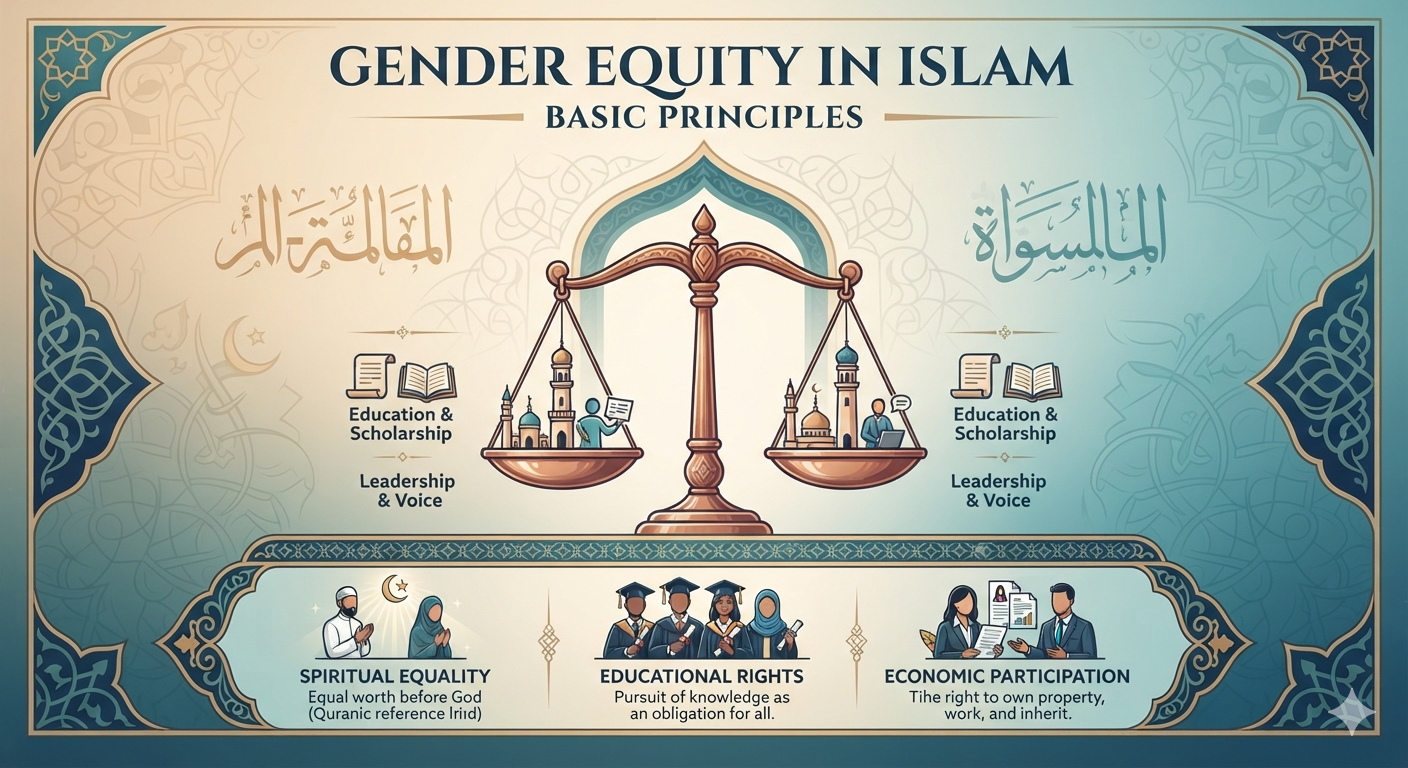
Equality and justice stand at the heart of the Islamic worldview. They are not abstract ideals or philosophical aspirations — they are lived principles, embedded in revelation, embodied by Prophet Muhammad (peace be upon him), and expected of every believer.
Islam’s message to humanity begins with a simple but transformative truth: all human beings share the same origin, the same dignity, and the same moral worth.
01
Equality Begins with a Shared Humanity
The Qur’an declares: “O humanity, We created you from a single male and female and made you into nations and tribes so that you may know one another. The most honoured of you in the sight of God is the most righteous.” (Chapter 49, verse 13)
This verse dismantles hierarchies of race, lineage, class, and gender. Human diversity is not a basis for superiority — it is a basis for recognition, relationship, and mutual respect. Honour is not inherited; it is earned through character.
Prophet (pbuh) reinforced this principle in his Farewell Sermon:
“No Arab has superiority over a nonArab, and no nonArab over an Arab; no white over black, nor black over white — except in righteousness.”
This was not rhetoric. It was a moral revolution.
02
Justice as a Divine Command
Justice in Islam is not optional. It is a Divine obligation.
“O you who believe, stand firmly for justice, as witnesses for God, even if it is against yourselves, your parents, or your relatives.”
Chapter 4, verse 135This verse establishes a radical standard: Justice must be upheld even when it is inconvenient, even when it challenges one’s own interests, and even when it exposes wrongdoing within one’s own community.
Islamic justice is therefore:
impartial — not swayed by wealth, status, or power
principled — rooted in truth, not emotion
protective — safeguarding the vulnerable
accountable — holding the powerful to the same standard as the weak
Prophet Muhammad (pbuh) demonstrated this when he said that even if his own daughter Fatimah (pbuh) were to steal, he would apply the law equally. Justice was not negotiable.
03
Justice Beyond the Courtroom
Islamic justice is not limited to legal rulings. It is a moral ecosystem that shapes how people treat one another:
fairness in trade
honesty in speech
compassion toward the weak
protection of the oppressed
humility in leadership
responsibility in power
The Qur’an repeatedly commands believers to “stand firmly for justice” and to “not let hatred of a people lead you to injustice.” (Chapter 5, verse 8).
Justice is not a reaction — it should be a character.
04
Equality in Practice: A Historical Transformation
When Islam emerged, it transformed a society built on tribal privilege, patriarchy, and class hierarchy.
Former slaves became scholars, generals, and leaders. Women became jurists, teachers, and transmitters of knowledge. Poor migrants and wealthy nobles prayed shouldertoshoulder, equal before God.
This was not accidental. It was the natural outcome of a worldview that sees every human being as:
created by the same God
born with the same dignity
accountable to the same moral law
05
Conclusion
Equality and justice in Islam are not slogans — they are sacred responsibilities. They call believers to honour every human being, to stand against oppression, and to uphold fairness even when it is difficult.
In a world still struggling with racism, inequality, and injustice, Islam offers a timeless reminder:
True honour lies not in power or privilege —
but in righteousness, compassion, and moral courage.