
✦ Women, Dignity & Family
Gender Equity in Islam
Twin Halves of One Humanity
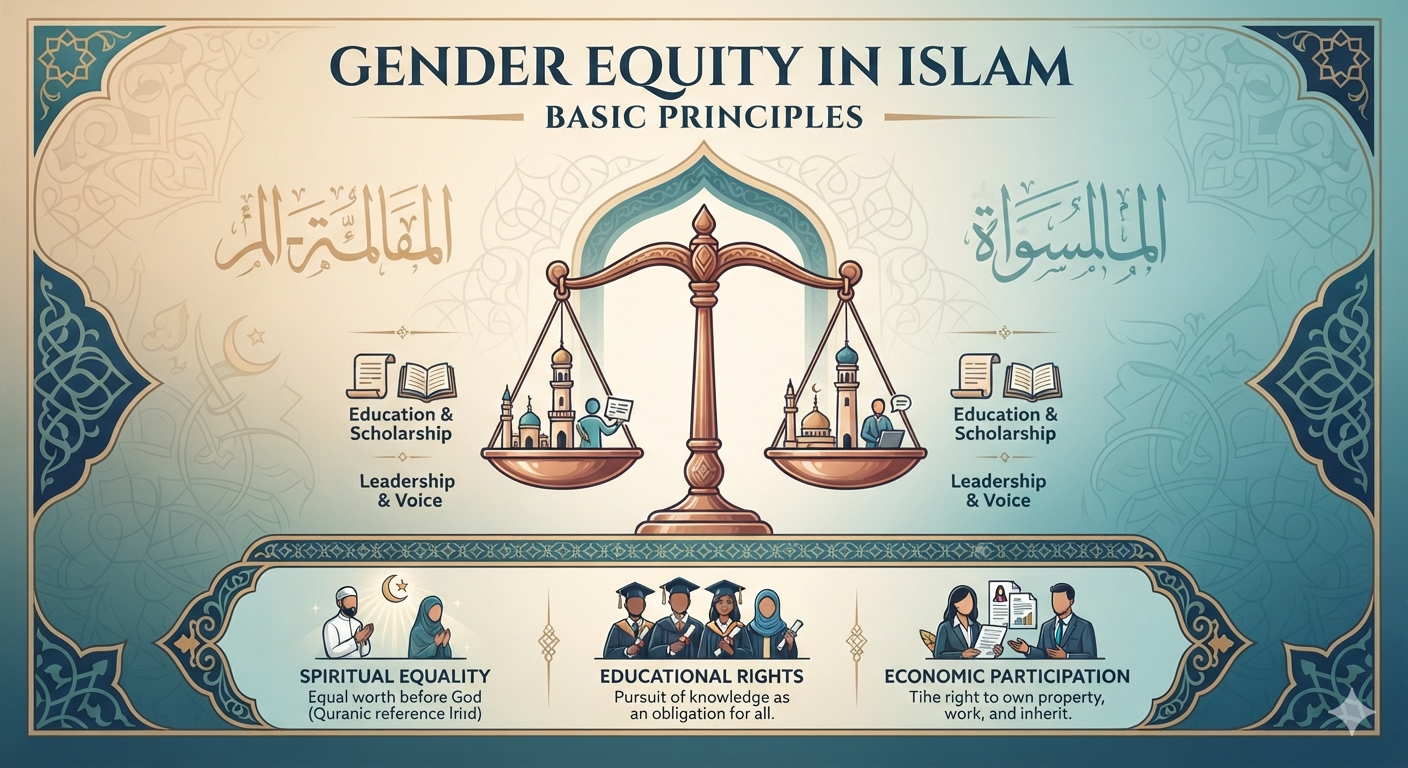
Gender equity in Islam begins with a profound affirmation of shared humanity. Aisha (peace be on her- the wife of Prophet Muhammad ﷺ) narrated that Prophet (peace be upon him) said,
“Women are the twin halves of men.”
This statement, delivered in a legal discussion, establishes that men and women possess equal moral worth, spiritual capacity, and human dignity. All subsequent legal distinctions are understood within this framework of essential equality.
01
A Timeless Faith in a Shifting World
Islamic reforms addressed clear injustices in 7thcentury Arabia — infanticide, exploitation, racism, and the denial of women’s personhood.
But modern debates around feminism, empowerment, and gender roles are shaped by cultural, economic, and ideological forces that differ across time and place. A wealthy woman in the West, a poor woman in Gaza, and a woman in preIslamic Arabia will not define “liberation” the same way.
Islam is not an ideology that evolves with trends; it is a timeless moral framework. To understand whether Islam empowers women, the most honest approach is to examine how women themselves experienced Islam when revelation arrived — and how men’s attitudes transformed as a result.
02
How Islam Restored Women’s Humanity
Islam’s transformation was both spiritual and legal. Women gained:
the right to inherit
the right to own property
the right to consent to marriage
the right to financial independence
the right to safety and dignity
Surah alAhzab (The Quran, Chapter 33, verse 35) places men and women side by side — believers, worshippers, the patient, the charitable — each promised forgiveness and a great reward. This is a declaration of equal spiritual standing.
03
Correcting Theological Injustice
Aisha (pbuh) once cried during Hajj because she started menstruating. The Prophet (pbuh) comforted her, saying: “This is something Allah has written for the daughters of Adam.”
This was revolutionary. In many traditions, women were blamed for Adam’s mistake, seen as spiritually impure, or treated as inherently sinful. Islam rejected this narrative entirely. Ritual impurity was never equated with spiritual inferiority.
The Prophet (pbuh) showed affection to his wives during menstruation, countering the practices of surrounding cultures where women were isolated or shamed.
Islam restored women’s humanity by restoring the dignity of their origin story.
04
The World Before Islam — A Necessary Contrast
Across civilisations:
Aristotle called women “defective men.”
Church councils debated whether women had souls.
English law allowed men to sell their wives until 1805.
In Arabia, daughters were buried alive — a practice the Qur’an condemned with piercing moral force.
However, The Quran dismantled hierarchies of gender, race, and lineage. It declared:
“The most noble of you in the sight of God is the most righteous of you.” (Chapter 49, verse 13)
05
Islamic Law: Equity, Not Inferiority
Critiques of inheritance or testimony often ignore context:
In 30 out of 34 inheritance scenarios, women inherit more than men.
Women’s testimony is equal or stronger in cases related to their expertise (e.g., breastfeeding).
The question is not whether differences exist, but whether the law was conceived to belittle women. The historical record shows the opposite.
Dr. Jonathan Brown notes a striking example: in 1947, a British colonial court overturned a Shariah court’s ruling because the Shariah court refused to accept “crime of passion” as an excuse for murder — a justification often used in honour killings. The Shariah court protected the woman; the British court protected the killer.
06
Conclusion
Islam should not be romanticised, nor should legitimate grievances be dismissed. But the solution is not ideological bandwagons — it is returning to Islam’s original empowerment.
Islam entered a society that buried women physically and morally, and within one generation produced scholars like Aisha (pbuh), whose authority shaped the entire community.
Gender equity in Islam is not a modern concession. It is a foundational truth:
07
women and men are equal in worth, dignity, and spiritual potential —
the twin halves of one humanity.