
✦ The Scriptures
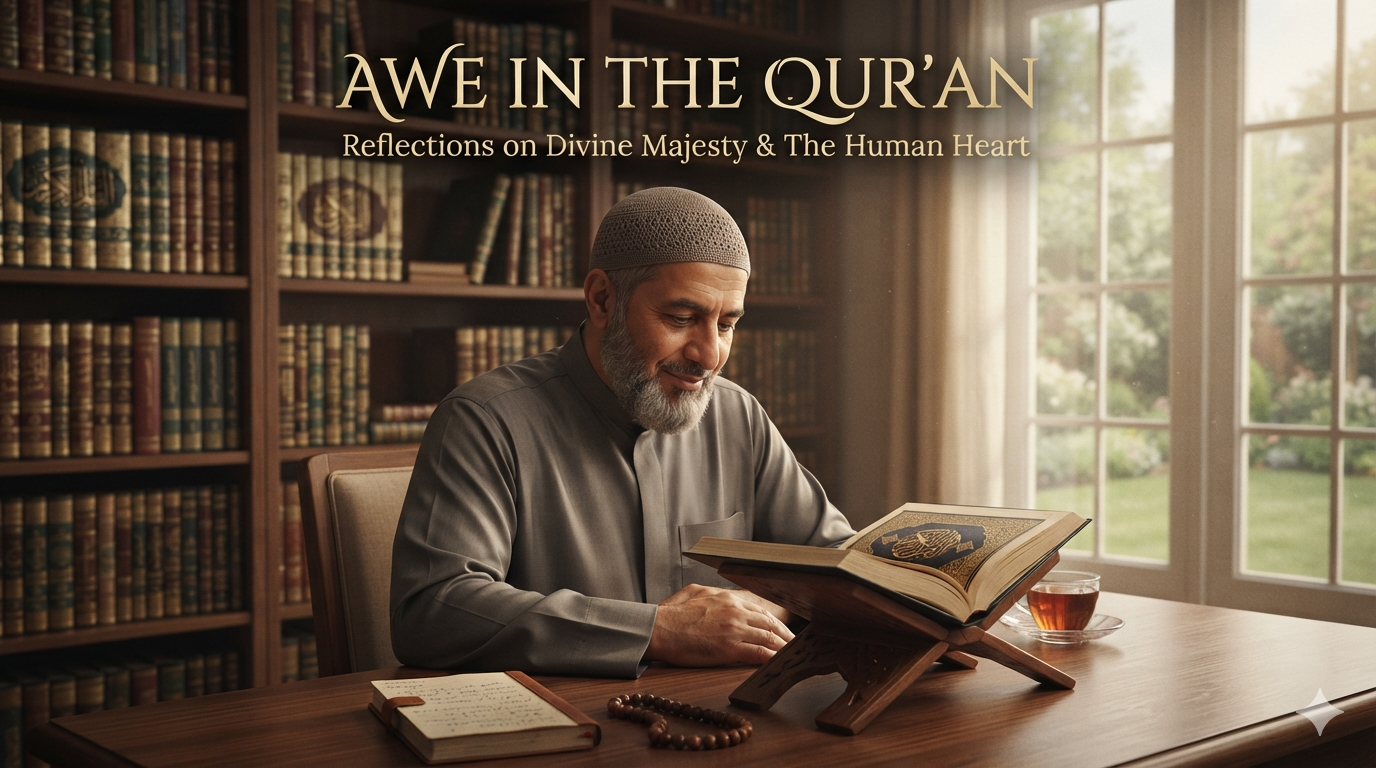
Awe in the Qur’an
The Qur’an Stirs the Human Heart
Awe is one of the most profound experiences a human being can feel. It is that moment when the heart pauses, the mind widens, and we sense that we are standing before something far greater than ourselves.
The Qur’an speaks to this experience with remarkable depth. It does not merely describe awe — it cultivates it, guiding the reader to see the world, the self, and the Creator with renewed clarity.
At its core, awe in the Qur’an is not fear, nor is it blind submission. It is recognition: a deep awareness of beauty, order, power, and meaning woven into every corner of existence.
The Qur’an invites the human being to look, reflect, and feel — to awaken from the distraction of daily life and rediscover the signs that surround us.
01
Creation as a Tapestry of Signs
One of the Qur’an’s central teachings is that the universe is filled with āyāt — signs pointing beyond themselves. The heavens, the earth, the alternation of night and day, the diversity of life, the inner workings of the human soul — all are presented as invitations to contemplation.
The Qur’an repeatedly draws attention to scenes that evoke awe:
The expanding heavens above us — “We are expanding it” (51:47);
The rhythmic alternation of night and day — “signs for people of insight” (3:190–191);
The human being himself — “within yourselves, will you not then see?” (51:20–21).
These verses transform the world into a gallery of signs, each one inviting reflection, humility, and wonder.
The Qur’an does not ask the reader to escape the world to find God. Instead, it asks us to look more deeply into the world. A sunrise becomes a reminder of renewal. Rain becomes a symbol of mercy. The human heart becomes a universe within.
Awe arises when the familiar becomes extraordinary, when the everyday reveals its hidden depth.
02
Awe as a Path to Humility
The Qur’an describes awe as something that softens and expands the heart. It humbles not by diminishing the human being, but by placing us within a larger, meaningful order. When a person recognises the vastness of creation and the perfection of its design, arrogance naturally dissolves.
This humility is not weakness. It is clarity. It is the realisation that we are dependent yet dignified, small yet significant, finite yet connected to the Infinite. Awe becomes a moral force — shaping character, nurturing gratitude, and grounding the human being in a deeper sense of purpose.
03
Awe and the Precision of the Universe
The Qur’an repeatedly invites the reader to examine the world with curiosity and intellectual honesty:
“Look again — do you see any flaw? Then look again, and again — your gaze will return to you humbled and exhausted.”
Chapter 67, verses 3-4This is not a call to blind belief. It is a call to investigate. The Qur’an presents the universe as a finely balanced system, sustained with precision and intention.
The Qur’an points
to the mountains as stabilisers of the earth (16:15),
the rain cycle that revives dead land (30:24),
the stars used for navigation (16:16),
the stages of human development in the womb (23:12–14).
These are not scientific claims but signposts — reminders that the world is not random, but purposeful. Awe becomes a bridge between spirituality and reason — a meeting point where the heart and mind recognise the same truth.
04
Awe Awakens Gratitude
When the heart recognises beauty, it naturally turns toward gratitude. The Qur’an’s repeated refrain — “Which of your Lord’s favours will you deny?” (Chapter 55) — is not a rebuke but a reminder.
Awe and gratitude are intertwined: one opens the door to the other. Gratitude becomes a way of seeing, a way of living with awareness rather than neglect.
05
Awe as Inner Peace
The Qur’an teaches that remembrance of God brings tranquillity to the heart. Awe is one of the purest forms of remembrance. It quiets the noise of the world, dissolves anxiety, and reconnects the human being with what is eternal.
In a world of distraction and uncertainty, awe becomes an anchor — a return to what truly matters.
06
A Way of Seeing
Ultimately, awe in the Qur’an is not a momentary feeling. It is a way of seeing the world. It is the practice of moving through life with humility, curiosity, gratitude, and presence. The Qur’an invites us to pause, to look again, and to rediscover the signs that were always there.
Awe is not rare. It is everywhere — waiting for the heart that is awake.