

✦ Justice
Economic Fairness
Protecting the Vulnerable with a Just Marketplace
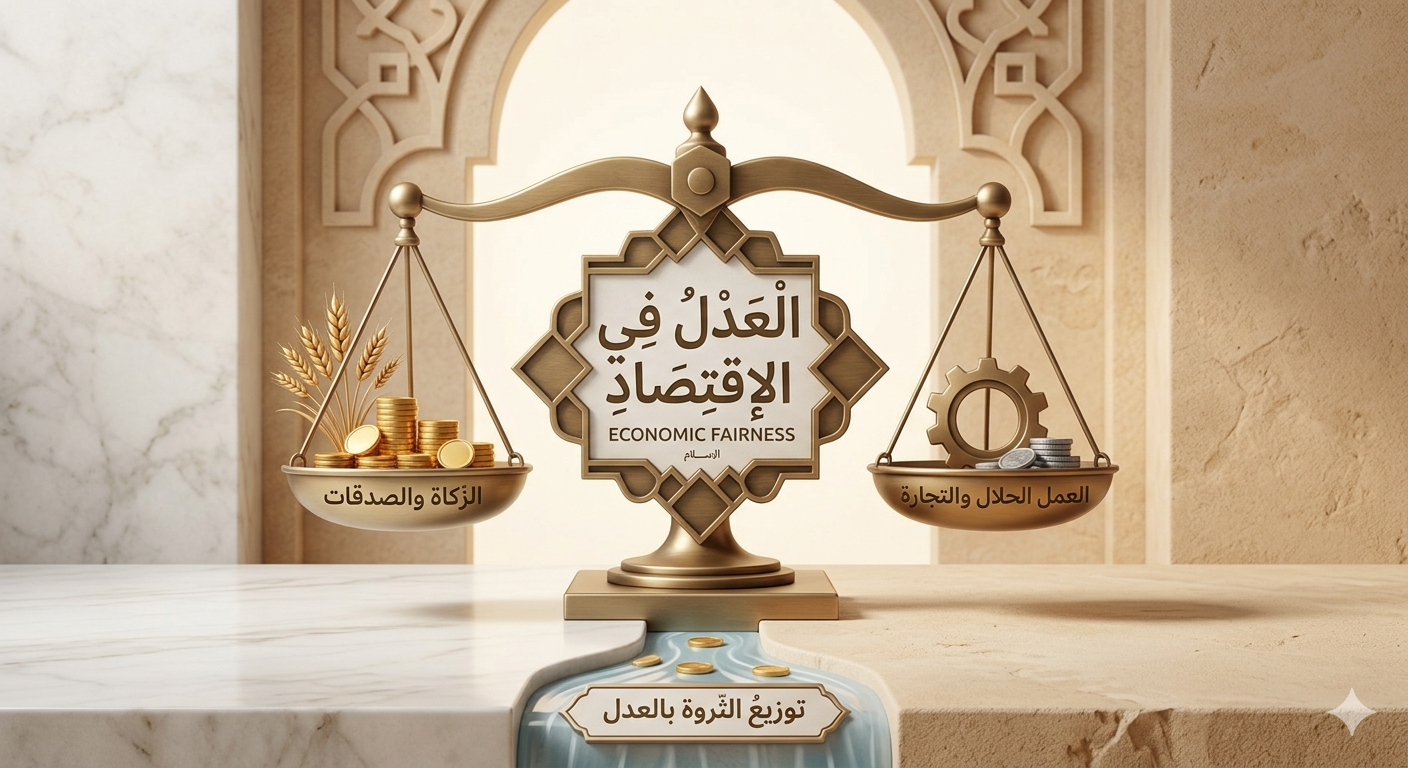
Economic life is one of the most powerful forces shaping human wellbeing. It determines whether societies flourish or fracture, whether people live with dignity or fall into cycles of exploitation.
Islam approaches economic activity not merely as a technical or financial matter, but as a moral arena — a space where justice, compassion, and responsibility must guide human behaviour.
The Qur’an repeatedly emphasises fairness, transparency, and the protection of the vulnerable, laying down principles that create a balanced and ethical marketplace.
01
Wealth as a Trust, Not an Absolute Right
In Islam, wealth is not an unrestricted personal possession. It is a trust from God, to be earned ethically and used responsibly. This worldview immediately places limits on greed, exploitation, and unjust gain. Wealth must circulate, benefit society, and uplift those in need. Hoarding, manipulation, and predatory practices violate the spirit of this trust.
02
Foundations of Economic Ethics
The foundational idea transforms economic life from a competition for advantage into a shared responsibility for collective wellbeing. Islam’s economic guidance is fundamentally about:
preventing exploitation
ensuring fairness
safeguarding the weak
promoting justice
3. Ethical Trade: Mutual Benefit, Not Exploitation
The Qur’an encourages trade, enterprise, and economic activity — but only when conducted with honesty and fairness. Ethical trade is built on:
transparency
truthful dealings
mutual consent
fair pricing
fulfilment of contracts
Prophet Muhammad (peace be upon him) described the honest trader as being “with the prophets, the truthful, and the righteous,” elevating commerce to a moral vocation.
A marketplace built on trust strengthens society; one built on deception corrodes it from within.
4. Why Interest (Riba) Is Seen as Unjust
Islam’s prohibition of interest is not a technical financial rule — it is a moral stance against exploitation. Interestbased systems often:
burden the poor
widen inequality
reward wealth without effort
trap people in cycles of debt
The Qur’an contrasts interest with trade to highlight the difference between productive exchange and unearned, riskfree gain. Ethical trade creates value for both sides; interest extracts value from one side for the benefit of the other.
By discouraging systems that prey on vulnerability, Islam promotes economic arrangements rooted in fairness, shared risk, and shared benefit.
5. Protecting the Vulnerable
Economic fairness in Islam is deeply tied to social responsibility. The Qur’an repeatedly commands believers to support:
the poor
the indebted
the traveller
the orphan
the marginalised
Zakat (obligatory charity) and voluntary giving ensure that wealth circulates and that no one is left behind. The goal is not forced equality, but dignity for all.
6. A Balanced Economic Vision
Islamic economic ethics aim to balance:
individual enterprise
social welfare
moral responsibility
community wellbeing
It neither endorses unrestrained capitalism nor rigid collectivism. Instead, it offers a middle path where markets thrive, but not at the expense of justice.
03
Conclusion
Economic fairness in Islam is ultimately about human dignity. It seeks to build a society where wealth is earned ethically, shared responsibly, and used to uplift rather than exploit.
By grounding economic life in justice and compassion, Islam offers a vision of prosperity that benefits everyone — not just the elite.