

✦ Justice
Trade vs Interest
Profit must be earned, not extracted at the cost of another
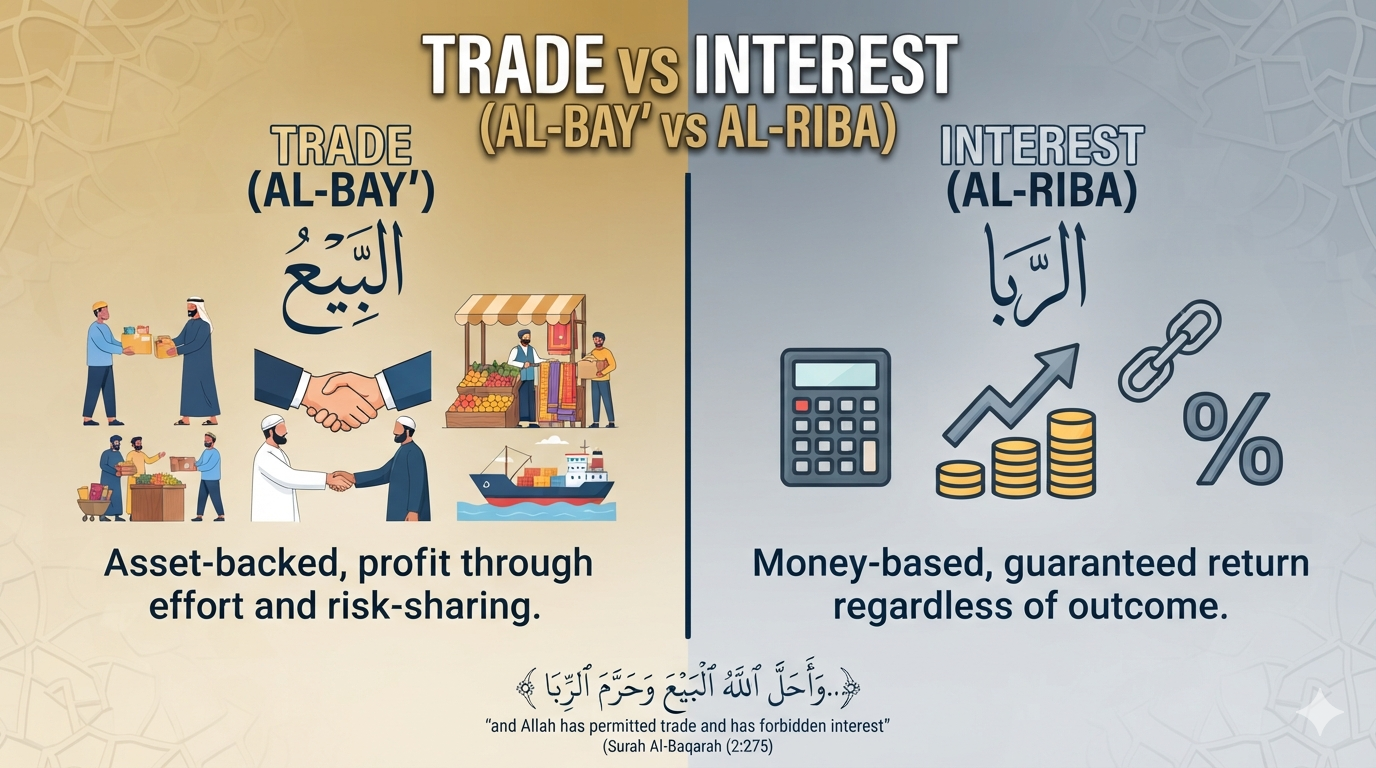
Trade is a natural part of human life. People buy, sell, invest, and build livelihoods through exchange. Islam embraces this economic activity — but it draws a clear moral line between fair trade and exploitative gain.
At the heart of this distinction is the prohibition of Riba, often translated as usury or interest, a practice that has historically enabled the powerful to profit from the vulnerability of others.
The Qur’an presents this issue not as a technical financial rule, but as a matter of justice, ethics, and human dignity. In a world where the poor were routinely trapped in cycles of debt, Riba functioned as a tool of exploitation.
Islam confronted this directly. The Qur’an states: “God has permitted trade and forbidden Riba” (2:275), drawing a moral boundary between productive exchange and predatory gain.
Riba is more than just charging interest. It represents any system where wealth grows without effort, risk, or shared responsibility — where one party benefits regardless of the other’s loss. This creates an unequal relationship in which the lender is guaranteed profit while the borrower carries all the burden. Islam rejects this imbalance because it undermines compassion, solidarity, and fairness.
The Qur’an’s strongest warnings are reserved for Riba because of its social consequences. It widens inequality, concentrates wealth, and erodes the bonds of community.
By contrast, Islam encourages economic models built on risksharing, partnership, investment, and real value creation. These principles ensure that profit is tied to contribution, not exploitation.
Historically, the prohibition of usury was not unique to Islam. Judaism and Christianity also condemned it for similar reasons: it harmed the poor, destabilised communities, and corrupted moral character.
Over time, however, many societies normalised interestbased systems. Islam preserved the original ethical stance, insisting that economic life must reflect compassion and justice.
Modern Islamic finance is built on these values. It avoids interestbased lending and instead promotes contracts rooted in partnership, shared risk, and tangible assets.
VIDEO from websiteVIDEO from websiteVIDEO from websiteVIDEO from website
Some of the Islamic finance models namely mudarabah (profitsharing), murabaha (costplus financing), or ijarah (leasing), the aim is the same: to create an economy where wealth circulates fairly and where financial relationships uplift rather than exploit.
This approach is not about rejecting modernity. It is about ensuring that economic progress does not come at the cost of human dignity. In times of global financial instability, Islamic finance has often shown resilience because it avoids speculative bubbles and prioritises real economic activity.
At its core, Islam’s stance on Riba is a moral vision: an economy that protects the vulnerable, prevents exploitation, and promotes justice.
It calls us to build systems where:
prosperity is shared, not extracted;
where trade is fair, not predatory; and
where wealth becomes a means of service, not domination.
In a world still grappling with inequality and debtdriven hardship,
this message remains profoundly relevant.