

✦ Stewardship
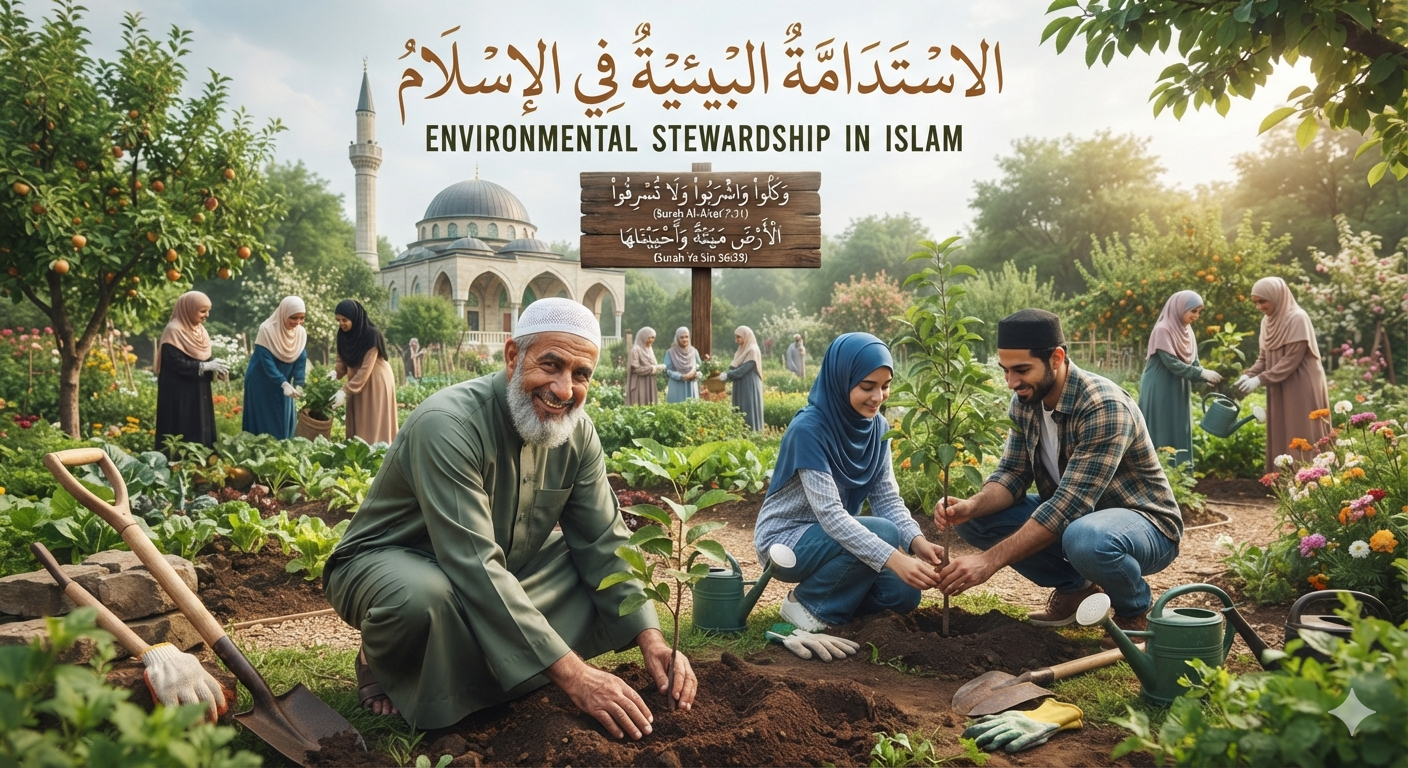
Environmental Stewardship in Islam
A Sacred Trust, A Shared Responsibility
Humanity today faces an environmental crisis of unprecedented scale. Scientists warn that climate change, rising sea levels, extreme weather, species extinction, and water scarcity pose a “clear and present danger to civilisation”.
The vast majority of climate experts — around 97% — agree that human activity is driving these changes. While political debates continue, the scientific consensus is firm: the planet is warming, ecosystems are under strain, and vulnerable communities are suffering the most.
Islam approaches this crisis not only as an environmental issue, but as a profound ethical and spiritual responsibility. The Qur’an teaches that the Earth is a trust (Amānah) placed in human hands, and that we will be held accountable for how we treat it.
Environmental stewardship is therefore not optional — it is woven into the very fabric of Islamic belief and practice.
01
The Earth as a Divine Trust
Islam teaches that everything in the heavens and the earth follows the laws set by the Creator. Human beings, too, are meant to live in harmony with these patterns. When we forget our purpose, we fall into excess, waste, and exploitation — behaviours the Qur’an strongly condemns. “Spendthrifts are brothers of the Evil Ones,” it warns, urging believers to avoid waste even when resources seem abundant.
This principle extends to daily actions. Prophet Muhammad (peace be upon him) once corrected a companion who used too much water while performing ablution, saying, “Yes, even if you are at a flowing river”.
Conservation, mindfulness, and moderation are therefore spiritual virtues, not merely environmental ones.
02
The Root Problem: A Crisis of Consumption
A striking observation is that many environmental campaigns focus on symptoms — saving forests, oceans, or endangered species — but rarely address the deeper cause: consumerism.
Modern societies often equate happiness with material accumulation, driving relentless consumption that strains the planet’s resources.
Islam identifies this as a spiritual imbalance. When people turn away from their Creator, they seek fulfilment in possessions, status, and endless consumption — but never find true contentment.
This inner emptiness fuels outer destruction. The Qur’an describes this cycle clearly: “Corruption has appeared on land and sea because of what people’s hands have earned” (Chapter 30, verse 41)
Environmental degradation, then, is not only a scientific or political issue — it is a moral and spiritual crisis.
03
Returning to Balance
Islam offers a holistic solution: reconnecting with God, living with purpose, and embracing moderation.
When the heart is anchored in faith, it no longer seeks fulfilment in endless consumption. Instead, it becomes content, grateful, and mindful of its responsibilities.
A Muslim is taught to see themselves as a caretaker of the Earth — someone who protects, nurtures, and preserves.
This worldview transforms everyday actions: reducing waste, conserving water, avoiding excess, planting trees, and caring for animals all become acts of worship.
Prophet Muhammad (pbuh) emphasised this beautifully: “even if the Day of Judgment were about to begin, a believer should plant a sapling if they can.”
This teaches that no act of care is too small, and no moment is too late.
04
Living Stewardship Today
While global solutions require governments and institutions to act, Islam teaches that individual responsibility matters deeply. Believers are encouraged to:
live simply and avoid waste
reduce harm to the environment
support ethical consumption
protect water, land, and animals
cultivate gratitude and contentment
act with awareness of divine accountability
These small, sincere actions — rooted in faith — create a culture of stewardship that can ripple outward into families, communities, and societies.
05
Conclusion
Environmental stewardship in Islam is not merely about protecting nature; it is about restoring harmony between the human heart and the world it inhabits. When we live with purpose, gratitude, and moderation, we honour the trust God has placed upon us.
And when we care for the Earth, we care for ourselves, our communities, and future generations.