

✦ Peace
Inner Peace & Tranquillity
A Calm Rooted in Spiritual Clarity
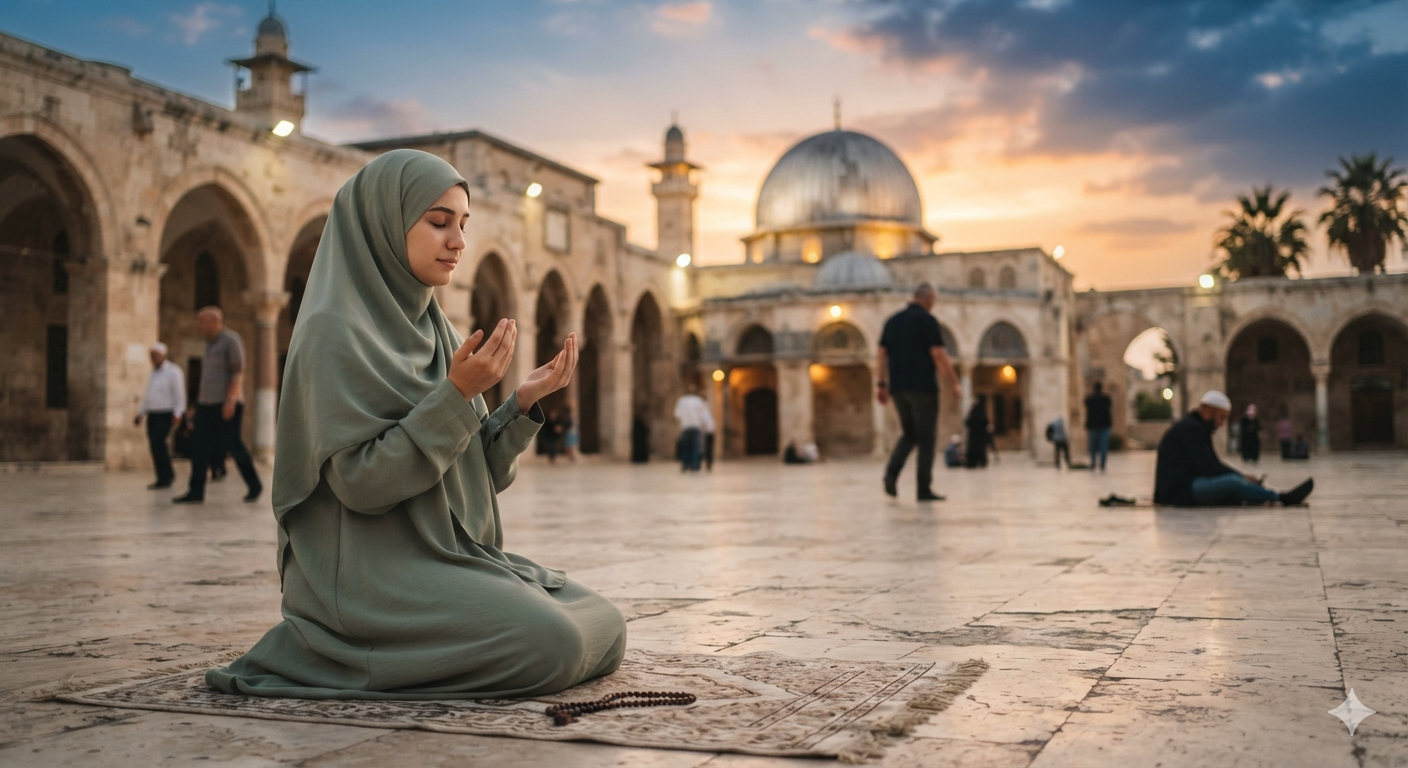
Inner peace in Islam is not the absence of difficulty; it is the presence of clarity. The Qur’an teaches that true tranquillity comes from a heart anchored in remembrance of God:
“Verily, in the remembrance of God do hearts find peace” (Chapter 13, verse 28).
This peace is not passive or escapist. It is an active state of grounding, where a person sees the world with perspective, understands their place within it, and trusts in the wisdom of the One who guides all affairs.
Inner peace becomes the foundation upon which all other forms of peace — social, relational, and communal — are built.
01
A Heart Steady Amid Life’s Uncertainties
Life brings moments of joy and moments of hardship. Inner peace allows a person to navigate both with balance. It is the calm that steadies the heart when circumstances shift, the clarity that prevents panic, and the trust that keeps despair at bay.
The Qur’an repeatedly reminds believers that trials are part of the human journey, but that God is “closer than the jugular vein” and fully aware of every struggle. This awareness transforms anxiety into patience, fear into resilience, and uncertainty into hope.
02
Trusting in God’s Decree
At the core of inner peace is ‘Tawakkul’ — Trusting in God’s plan. This trust does not mean abandoning effort; Islam encourages striving, excellence, and responsibility. But it frees the heart from the burden of trying to control every outcome.
A person who trusts in God works sincerely, then rests in the knowledge that what reaches them was meant for them, and what misses them was never theirs. This trust creates emotional stability, allowing the heart to remain calm even when life feels unpredictable.
03
The Prophetic Model of Tranquillity
Prophet Muhammad (peace be upon him) embodied inner peace even in moments of intense pressure. Whether facing hostility, loss, or uncertainty, he remained composed, gentle, and clearminded.
His (pbuh) tranquillity was not detachment; it was deep spiritual grounding. He taught that strength is not in overpowering others but in controlling one’s own reactions.
Through his example, inner peace becomes a moral discipline — a way of responding to life with patience, dignity, and emotional intelligence.
04
Cultivating Peace Through Daily Practice
Inner peace is nurtured through small, consistent acts:
prayer that centres the heart,
reflection that clears the mind,
gratitude that shifts perspective, and
compassion that softens the ego.
The Qur’an describes believers as those whose hearts are illuminated by remembrance, whose emotions are balanced by trust, and whose actions are guided by sincerity.
These practices create a quiet inner space where calm can grow, even in a noisy world.
05
A Foundation for Social Peace
Inner peace is not only personal; it has social consequences. A person who is calm inside is less reactive, less harsh, and less prone to conflict. They listen more, judge less, and respond with patience rather than anger.
In this way, inner tranquillity becomes the seed of social harmony. Communities built on calm hearts are communities where conflict is softened, relationships are strengthened, and peace becomes a shared reality.
06
The Gift of a Settled Heart
Inner peace is ultimately a gift — a state where the heart rests, the mind clears, and the soul feels held by God. It is the quiet strength that allows a person to walk through the world with balance, clarity, and hope.
In Islam, tranquillity is not merely an emotion;
it is a spiritual posture that elevates the human being and
prepares them to build peace in every sphere of life.